1)I saw Berberian Sound Studio in the worst possible circumstances: I watched the entire thing on my iPhone over several sessions walking on an elliptical machine at my local gym. Cardio is both necessary and incredibly boring, and I had gotten sick of listening to podcasts while I worked out. I saw some less-than-stellar movies, but Berberian Sound Studio captured my imagination. I got into Only Lovers Left Aliveat around the same time, and I've been a fierce advocate for both films since. It seems like there have been a lot of smart, classy horror films over the last few years and I was really excited to share them with people.
2) Like Only Lovers, Berberian is total sound porn. Instead of music, Berberian focuses on the sound engineering and foley work used to make an effective horror film. I've never seen a film that made such brilliant use of sound effect work.
3) Confession time: I've never much cared for the "golden age" of 1970s Italian horror cinema. I think most of the appeal comes from a strange mix of nostalgia for an era that was before my time, a misreading of incompetent film making that gets confused for camp, and a gorehound's delight in a few key scenes of truly nasty gore effects. I'm watching Lucio Fulci's Zombie 2 on the second monitor as I type this and no one ever remembers anything substantial about the film. They just remember the eye gouging and the shark fight. I do like The Beyondand the Argento film Phenomena but Italian horror doesn't really work for me. But it does make a fantastic backdrop for Gilderoy's mental breakdown.
4) I am embarrassed to admit it, but I see far too much of myself in Gilderoy. I'm small and easily bowled over, and I'm often shocked when people act selfishly. His timid personality puts him at a huge disadvantage when he's brought to Italy to work on some perverse giallo film. My own experience in Italy taught me that the people can often be, um, unnecessarily assertive. A sheltered person like Gilderoy would easily be bowled over. Gilderoy's immediate supervisor is rude to him without reason, the receptionist is dismissive, and everyone either blows him off or talks down to him. The only one who treats Gilderoy decently is the film's director, and he's a manipulative narcissist with grandiose ideas about the misogynist trash he's creating.
5) The film takes places in a strange film noir world. The hallways disappear down impossible distances, the rooms never seem to be properly lit, and the recording rooms are all like tiny coffins. The entire movie world feels like an echo chamber, which is perfect for the best aspect of Berberian Sound Studios: the masterful use of sound.
6) I've never seen a movie so lush with aural detail. You never actually see the movie Gilderoy is helping to make, but the horrific special effects conjure up a pretty clear image of how nasty the movie must be. Sound is used to brilliant effect in the film. Every cut lettuce, every dropped melon feels like a violation of the human body. I've heard a thousand screams captured on horror cinema, but I've never heard anything as gut-wrenching as the screams of frustration captured in the recording booth.
7) The movie follows Gilderoy's descent into madness, as his life begins to thread into the movie. Perhaps the occult nature of the film casts a spell on him, perhaps he starts going insane, perhaps he was insane to begin with, a man who appeared out of the film itself. The ambiguity made the ending frustrating for a lot of people, but I found it intriguing. I can't wait to go back and revisit the film. Hopefully next time on a better screen.
Conclusion: I've never seen a horror film that so effectively used the mechanics of cinema to deliver tension. Watching Gilderoy degenerate to the chaos around him becomes almost operatic. The line between film and "reality" gets razor-thin over the course of the movie. It's a rare treat, and one of my favorite recent horror films.
Richard Laymon has always been hard for me to pin down.
I tend to pay a lot of attention to the subtext underneath fiction. It's very difficult for me to accept a story at face value. I always try to derive deeper meaning to the work, often when it isn't there, or I try to tease out the creator's motivations. Horror is particularly fertile ground because so much of the genre is symbolic. It's also often troublingly regressive. Horror is the genre of Don't: don't go into the woods, don't disturb the home, don't have sex, don't transgress, don't stray from the straight and narrow.
So I've always had a hard time wrapping my mind around Laymon. In short, he is either the biggest misogynist or the most subversive commenter on male entitlement in horror fiction.
Reading Laymon is a squicky affair. He writes a lot about sex, but it's the kind of hyper-described soulless mashing of anatomy that turns off anyone short of a Penthouse forum reader. It's always aggro, vaguely abusive, and unerringly predatory. Which isn't to say those things can't be fun, but there's something distancing and uncomfortable about the way he writes sex scenes that makes me feel like I'm watching particularly vicious porn in a room full of leering, past-their-prime frat dudes.
On the other hand, he never portrays predatory sexuality in a positive light. His leering men are usually brutal caricatures of unrestrained male sexual aggression. I've written a little about him in the past and it seemed that the point of his stories was that there's a slippery slope between entitled creep and misogynistic psychopath.
Laymon has sadly passed away. I've only been able to dig up a handful of interviews with him and they rarely address the subtext of his work. I do find it fascinating and ultimately rewarding. Either he was a complete creep or he was a master at getting into the mind of creeps and forcing us to see life from their perspective.
Night Show is the story of Tony, AKA The Chill Master. Tony is an 18 year old kid with severe psychological issues. He gets off on scaring people, he has no understanding of boundaries, and he becomes fixated on people he's attracted to. We first meet him as he kidnaps a girl who had previously rejected him, then tying her to a bannister in a supposedly haunted house. Following that misadventure, he leaves his home in upstate New York for Hollywood, intent on apprenticing with gore effect maestro Dani Larson. Dani is at first unsettled by Tony's outlandish behavior, but reluctantly takes the young man under her wing. He becomes fixated with her and works to sabotage her new relationship and take his place as her new lover.
I really enjoyed this book. Aside from the fact that it hit all my Fangoria Magazine/Tom Savini buttons, the way that Laymon portrayed Tony's mental instability felt spot-on. He felt like a more accurate depiction of a psychopath, at once charming and manipulative but fixated on his own needs and unable to understand how his actions affected other people. What made Tony so dangerous was that he just didn't get it. He didn't understand how his behavior affected other people. His social abilities extended only as far as his own needs.
Most psychopaths in genre fiction aren't truly insane. They're evil and sexy. They sit in their little see-through cages and glower at the haggard detective with a knowing smile on their lips. That's not a person with a serious mental illness; that's just Dracula with no superpowers. Tony is sick and needs help. The potential damage a sick person can do is much scarier to me than just another bad-for-bad's-sake dude.
My favorite aspect of Tony's insanity as that he doesn't physically hurt people. Sure, there is violence in the book, but Tony's Chill Master schtick never actually causes permanent physical damage. I've seen dozens of stories where a person's fixation on violent media turns them into killers (looking at you, Scream) but Tony asserts his power by terrifying people, not hurting them. We're never quite sure how far he's willing to go as he becomes more fixated on Dani and the tension of escalation is more rewarding than simply dropping bodies like a slasher movie.
I suppose I'm always going to wrestle with my reactions to Laymon's work. He's a good enough writer to keep reading, but his subject matter and presentation make me want to take a shower. The ambiguity of his intentions will always get to me and I'm sure I'll hate the next book I come across. But I've enjoyed my experiences with his work, so long as I take long breaks between reading his novels.
I found my copy of The Killing Joke among my dead brother's things.
I don't know if I loaned it to him and never asked for it back or if it was a copy he bought during one of the comic cons I dragged him to. It was one of the few things I gave him to try that he liked. He was never going to be the pop culture junkie I was....pop geekdom requires a certain level of uninhibited enthusiasm and Dominic Borrelli was an eye-roller if ever there was one....but V For Vendetta resonated with his mid-college angry Green party mentality. Burn down this corrupt world and the poisoned systems that supported it! I loaned him my copy of V For Vendetta and when he was done with it I said hey, you liked that one. Well, Alan Moore wrote another story about a maniac. Maybe you'd enjoy it.
He didn't have many other graphic novels. He didn't have much of anything. They say that suicides give away things they own before they kill themselves but my brother never exactly hoarded the way I did. I have a comic collection that's thousands deep, folios full of obscure yakuza/kung-fu/horror movies, artwork, posters, toys, collectibles, and all the other petty crap of a guy with the attention span of a hummingbird. My brother liked big things. He pissed away a lot of money on a souped up car during his Import Tuner phase and his laptop could probably give navigation assistance to space ships. Beyond that, he owned very little. He had an almost Buddhalike detachment from the material world. Had his story not shaken out the way it did, I would have found that trait admirable.
It's corny to say this but I was into the Joker long before he got popular.
I'm writing this while looking at a tiny Joker statue that sits on my desk. He's got his hands up in a ta-daa pose, the consummate showman. We've spent an entire semester talking about maniacs and their grubby little neuroses and the petty ugliness of the horrors they inflict. The Joker is all of those things, but he's also a showman. That dichotomy always drew me to him. Yes, it's probably forced and way too manic-slash-needy, but the guy seems like he's really having a good time.
I've been collecting Joker memorabilia for years. I had a shelf in my old apartment dedicated to all the statues and figures I could collect of him. My ex-girlfriend and my mother used to add little pieces to my collection. It was one of those tiny signs that showed they were paying attention and that they loved me. Give me those small gestures over the operatic melodrama of fictitious love any day.
The Joker is the avatar for my id. I'm drawn to trickster figures, whether they are Coyote or Anansi or kitsune or Bacchus or Dionysus or Bugs Bunny. I like funny, chaotic, life-of-the-party types. Given a choice, I prefer not to live in silence. For me, heaven is an endless party with really good music and hot chicks and drinks on someone else's tab. Give me laughter over silence any day.
Just make sure they have a really good reading couch to nurse hangovers on and read.
******************
I fell in love with the Joker specifically because of The Killing Joke. A junior high school teacher gave me a copy of the book and it sunk in with me.
I grew up during the iron age of comics. All the guys had muscles and knives, all the girls had porn-star breasts, no one wore any clothes, and everything was covered in blood. It was taboo and dramatic and fun and completely mind-blowingly stupid. Because we're a nation of repressed yokels, we equate "mature content" in our story telling with the sensational. People keep telling me that horror is all about the visceral, that everything in my genre is blood and tits. Mature storytelling can take all sorts of subject matter and apply depth and humanity to them
The Joker became my avatar when I started growing up, realized that life was unfair and uncaring, and I was going to die and there was nothing waiting for me afterward.
After you figure that stuff out, you've got three options. One, you find a system of lies and you believe in so hard that you ignore that nagging little voice in the back of your mind. Two, you shut down and become a French film student.
Or three, you throw a really good party and keep laughing until the lights go out.
*****************
I talk about my brother a lot.
I go to a siblings of suicide support group. I participate in suicide prevention walks. I slip it into casual conversation. I've had a hard time filtering out the information when I talk to people. It makes people uncomfortable and it tends to dominate the conversation and casts me in the role of Grieving Person but it's hard for me to stop myself. I want to talk about it. If I keep it up, it will become my identity.
I received the class syllabus while I was back in San Francisco, watching him go. I bought all my books at my favorite sci-fi/fantasy/horror bookstore (Dark Carnival in Berkeley, CA. If you're reading this, you should go there. It is to readers what Santa's workshop is to greedy children) and I started hacking through them as quickly as I could. When I saw The Killing Joke among my brother's things, I knew I had some shit to say on it. It was such an important part of my upbringing and I'd had the opportunity to see the work with fresh eyes.
Here's my take on the story: it's not a tale of madness but a tale of mourning.
Both Batman and the Joker are creatures created by grief. Something terrible happened to both of them and they dealt with it different ways. Batman turned his grief inward and turned broody. The Joker projected outward. I don't even think the Joker is particularly crazy. He's flamboyant and evil and comic-book crazy, but the things he done is a natural continuation of the things that happened to him.
******************
My brother was a brooder.
He was introverted and kept to himself, which always mystified me because he was a very handsome young man. I once took him to a friend's party and all these cute hipster girls kept asking me about him. "He's so cute!" they'd tell me and I'd seethe with jealousy and he wouldn't move an inch from the couch and not talk with anyone.
Our relationship was somewhat adversarial. I tortured him throughout his childhood and I spent my adulthood trying to make it up to him. We had a pretty good adult relationship but there was always tension between us. It didn't help that my brother got the bulk of attention. He needed it, obviously, but it felt like I was trusted to just be fine.
I contextualized my relationship using pop culture characters. If he were the selfish, destructive Loki, I was the noble idiot Thor. If he was the too-serious, brooding Batman then I was the loud party boy Joker.
When my brother was in his hospital bed, they encouraged us to play his favorite songs and talk to him. "You never know what they can hear and music helps."So, after a bunch of pandora stations and Hawaiian music and stuff like that, I found one of the cut scenes from the video game Metal Gear Solid. It's about two brothers at war with each other. The dark one is the hero and the loud vibrant one is trying to resurrect the apocalyptic dream of his dead father.
One lived and one died. What does the Joker do without Batman?
The Killing Joke was the first real attempt (as far as I'm aware of) to humanize the Joker.
A lot of smart, serious comic fans complain about the Joker. He's one note. He's an atrocity factory. There's no rhyme or reason to what he does and the trails of bodies that he leaves in his wake is proof-positive that Batman is completely impotent. The best example of this point of view is below:
The Killing Joke is the first and pretty much only attempt to make him anything approaching a real character. Other writers have built on little aspects of this story, but most of their efforts slip into campy angst. During the one moment of lucidity that the Joker has, after he plays the popgun prank on Batman, he's not bemoaning his fate or weeping for the man he once was. He just stands before Batman, resigned and exhausted, asking why Batman doesn't kick the hell out of him for all the things he's done.
The entire scene of Batman reaching out to the Joker takes all of a page and a half. It's short and there's a tremendous amount left unsaid, but it feels authentic and natural in a way that longer speeches would have felt artificial. There's a lot of weariness and dull pain between the two of them and it fills the scene.
Brevity is often the best choice.
****************
There's a lot of people who think that the final pages of the story, where the Joker and Batman are laughing at the same joke about two lunatics striving for salvation, means that Batman is just as crazy as his nemesis. I hate that interpretation. Batman isn't crazy, or at least not in the same way. But he has felt tremendous loss in his own life. That moment of shared humanity allows them to laugh at the absurdity of their situation.
Plus, okay, maybe they're a little nuts.
That, to me, is a better ending to The Killing Joke. We deal with our grief in our own ways. Some brood and go inward, some project and go outward, but either way it changes you.
Of all the books I had to read for class, Misery is the one I felt the most apprehension about.
A story about a psycho running at me with a knife doesn't really rattle my cage. It's a situation that (thankfully) seems so far-fetched to me that I don't get a lot of anxiety over it. Having a conversation with a crazy person who is responsible for your safety is much more frightening.
Reading Misery was an intense experience.
Most of the people who read this blog know me in real life. I have a fairly over-the-top vibe and a big flapping mouth, but I don't actually deal with conflict well. Blame the screaming matches my parents got into as a kid or whatever cheap pop-psychology explanation fits best, but the long and short is that I prefer things to be peaceful. I want to be liked. I try to please. Sometimes that means rolling over and showing my belly.
The reason that I found Misery so stressful was because, if it were me in Paul Sheldon's chair, I would have done everything I could to make Annie Wilkes happy. I would have told her that Misery's death was simply a lead-up to a sequel where she comes back triumphant. I would have shmoozed her, gushed at her enthusiasm, and answered every one of her fan-girl questions with the answers that she wants to hear. Yes, Misery eventually chooses handsome Edward but keeps a special place in her heart for brooding, passionate Jacob. Yes, I will be writing these stories forever (although, come on, what kinda dude's dude writes Regency romances? The way Sheldon comes off, he should have been writing stories with .45s and tits) and I'm sorry that you found the swearing in my new novel so offensive. I'm trying to capture the streets my character comes from. In my next draft I will tone it down and add a modern Misery. Agony Velasquez, maybe.
As I was reading the book, I kept roleplaying what I would have said and how I would have placated her, but the simple answer is that she's unpredictable and crazy and sooner or later I'd have to stop placating her and start being assertive. The threat of death, mixed in with the threat of disappointing a domineering mother figure, rattled me in ways that I'm kind of embarrassed about.
King is a good writer.
It's trendy to trash King for his weird period in the 90s when his books were at the same time too personal and too bloated. It's trendy to talk down about him because the Uneducated Masses really dig him. When I first got to New York City and was struggling to get by, I knew that I could go to any Salvation Army, slap down a dollar, and have entertainment for hours. His stuff is ubiquitous and that means it's taken for granted. He writes about podunk towns and podunk people (snotty snort, eats some cheese), but the man knows how to capture humanity and human weakness. His images stick in the mind.
Having said that, his pulpy Tales From The Crypt roots sometimes work against him.
I gotta lay out the one petty issue I had with the book. It's the same problem I had with Apt Pupil, where the villain went from a small, believable sort of banal evil to an obnoxiously grandiose cackling lunatic. Todd in Apt Pupil starts off as just a teenager taking lessons in sociopathy from an old kook, then goes off and starts hacking up homeless people? No. Annie Wilkes is a mass murderer living in isolation? No.
There's a scene where trapped novelist Paul Sheldon finds Annie Wilkes' scrapbook locked up somewhere. He flips through it and it turns out that she killed enough people to fill a city. It stretches credibility and takes the character to a farcical territory. Given that the horror is so close and intimate, it would have worked better if she was just a lonely woman out in the woods whose identity was so wrapped up in her fictional avatar that she goes nuts.
I understand that people feel Annie Wilkes is a mean-spirited stereotype of the crazy woman or romance readers or obsessive fans of anything in general. Yeah, maybe. But people get weird about the fictitious characters they empathize with.
Guilty.
I gotta close this one out by discussing the circumstances I read this book in.
I'd been hearing about Misery for a long time. Everyone knows about the movie, which I tried to watch but just couldn't finish, and everyone says it's one of King's best tales. It's supposed to be of special significance to writers, too. A hundred years ago, I read an interview with Gothy horror writer Poppy Z. Brite and she said that Misery was one of the best how-to-write manuals she'd ever encountered. I was really looking forward to that aspect of the book. I HATE books on writing but making the mechanics of storytelling a part of the story weaves how writing actually works and impacts a human life. It's a Scheherazade piece and there's something weird about how thrilling the idea of keeping yourself alive by telling stories is.
Telling stories keeps you going. I read Misery right after I lost someone I loved. I didn't want to write. I didn't want to love or fuck or dance or drink or do any of the things that defined my life. I wanted to lash out. I sometimes do, and I sometimes go dancing. Reading Paul Sheldon's story helps me work through my own.
I doubt I'll read this again anytime soon. It was easily the most hairy book I read this semester. I like a good psycho story but I think I'll stick to nice, safe stalk-stalk-knife-knife-misogyny-religion-daddy issues stories. But it was the right thing for me to read at the right time.
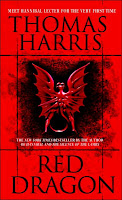
I got it in my head at age 19 to get a big-ass dragon tattooed on my back. It was my first tattoo and it promised to be a doozy, so I took my entire rent check and wandered down to Telegraph avenue in Berkeley, CA. I walked in, paid my money, and sat in the chair.
Getting poked for seven hours isn't exactly a lot of fun but somehow I endured. In between the controlled karate breathing and occasional reminders to myself to uncleeeeench, I finished the book. The story of a man who believes himself to be ugly and reinvents himself as a dark, majestic god deeply resonated with me then and it still does now.
As a wanna-be writer, re-reading Red Dragon deeply intimidated me.
Sooner or later, all modern psycho stories become police procedurals. You have to have some reasonable grasp on how law enforcement works. I'm a research monkey in general, but if a serial killer was operating on the scale and violence of Francis Dolarhyde, then a writer would have to account for the massive amounts of resources and expertise that would be turned toward his capture. Harris has a background in crime reporting and, like The Wire's David Simon, he uses that insider knowledge to enrich his story. When I think about replicating it, I imagine having to know the structures and methodologies of federal agencies, the science of forensic pathology, and all the other details that make these sorts of stories work.
Granted, audiences are pretty forgiving. Cop shows on TV aren't particularly accurate, but people eat them up. But the smallest screw-up kills all that built up suspension of disbelief and I care about the small details. A good, effective, authentic police procedural is like a finely made watch and I don't know if I am a good enough watchmaker.
I'm going to get this out the way because I cover a lot of this ground in my Silence of the Lambs podcast, but I am kinda over Hannibal Lecter.
First, he's not really an authentic psychopath. He's too clever, too controlled, he lives in a creepy dungeon, and his abilities verge on the paranormal. He's basically a modern-day Dracula.
I like Dracula and Hannibal Lecter is one of the best monsters that has been created in the last 30 years, but I'm more interested in the psychological nuances of the other villains in Harris' work, both Buffalo Bill from Silence of the Lambs and the Dolarhyde from Red Dragon.
Plus, frankly, for all the bluster about how clever Hannibal Lecter is, he always seems to be undone by his own arrogance. In their first encounter, he screws with Will Graham but immediately capitulates when Graham prepares to leave. He receives a letter from Dolarhyde and, rather than destroy the whole thing, he keeps the part that strokes his ego. Lecter is terrifying, but he's got a pretty significant achilles heel. It's the kind of thing comic book villains get tripped up on all the time.
Please don't tell him I said that.
On to Dolarhyde.
I sort of live by the philosophy of "fake it until you make it." If it were up to me, I'd spend my free time in blissful bookish solitude. But having friends and building a life and being popular has taught me savoir-faire and social adaptability. Those who know me (and I'm assuming most of the people who read this know me personally) can attest to my massive personal charisma, but it was a learned skill, not something that came naturally.
I cannot tell you how many times I've stared at my own reflection in the mirrors of nightclubs and douchey bars, looking at the fear in my eyes, and telling myself to put my game face on. The shortcut I used to developing a social persona was to copy the behavior of brighter, more charismatic people.
In other words, I created an avatar of the person I wanted to be. It's a much more minor version of what Dolarhyde did. I suspect every bullied, tormented, and angry kid does the same thing. When I was little, Jason Voorhees was my anger avatar. Dolarhyde's avatar is the Dragon. I sympathized with him, and it disturbed me.
Plus....sigh...let's just say I can empathize with Dolarhyde's body image issue. More than I'd like to admit.
If Dolarhyde simply remained a well-designed maniac then Thomas Harris would already be ahead of the game. But the thing that makes Red Dragon special for me is that he starts redeeming himself from his own madness.
Okay, Reba McClane is a little bit too perfect for the circumstances. She's blind, so Dolarhyde's body image issues aren't a problem. She was a trained speech expert so she knows exactly what to say to alleviate his fears. And, of course, she's sexually confident enough to break through his barriers. Suddenly he's fighting his psychosis and trying to make deals with the Dragon. It made him a deeply tragic figure and one of my favorite psychos. Most psychopaths in horror fiction aren't really crazy but are instead cookie-cutter pulp fiction cackling evil. They do terrible things because it's fun. Dolarhyde's actions come from human weakness and insanity. I don't know if I buy that Dolarhyde would backslide so far as to attack Graham in his home, though. He was too confused and conflicted by Reba to suddenly turn into a third act monster movie villain.
Still, Dolarhyde has the one thing that most fictional psychos lack: authenticity.
It probably is clear now that I really enjoyed this book, probably more now than when I first read it. Harris is a helluva writer and I enjoy it more now than I did when I first read it.
My final thought is something Hannibal says to Will Graham. Graham's big secret superpower is his uncanny ability to empathize with a killer's point of view and anticipate their behavior. Maybe it's the fact that I've always had a big imagination and it mostly turned to darker places, but the line "Fear is the price we pay for imagination" stuck with me. It's true, or at least it's true for my imagination. The upside? Fireworks behind my eyes. The downside? Lots and lots of sleepless nights with monsters under the bed.
I grind out the books for and knock out the blogs for this way in advance. I like to have something ready to go, I like to get a thought on paper early and let it percolate for awhile and I hate rushing through things at the last minute. I carry my books with me where ever I go, but when you're studying horror fiction you're going to get a lot of strange looks over your reading material.
Anyway, midway through the book, I decided to take in a burlesque show from the fine people at D20 Burlesque for their WTF Japan anime-themed costumed night. I had bought the tickets well in advance but I wasn't able to convince anyone else to go, my personal life turned into a hot mess, and I found myself in the front row seat, alone, in a bad mood, and with a bunch of naked girls wondering what kind of aspiring serial killer brings a copy of The Church of Dead Girls to a burlesque show.
Clever, clever me...
Anyway, I was midway through The Church of Dead Girls and I wasn't really feeling it. Dobyns is a really good writer, but the framing device of having a withdrawn, intellectual townsperson narrate it drained any sense of tension from the story. I see why Stephen King liked it, as his blurb is prominent on the cover. King does the folksy narrator unspooling a yarn very well, but this story takes the voice of an uptight closet case middle school teacher and therefore feels cold. Midway through the book, I felt like I was reading a wikipedia page summarizing events rather than actually engaging in the storyline.
It doesn't help that the narrator has no way of knowing some of the details in the story while being maddeningly coy with others ("Who's the 'professional man'?" "I'm not telling yoooooooouuuu."). I kept waiting for the big tweest to be revealed where the narrator was the killer (in retrospect, he probably was) or the narrator was secretly dead or something. It was an odd mix of omniscient and focused narrative.
It strikes me that this is an interesting selection for my Psychos In Literature course. We don't discover who the killer is until the end of the book, when an otherwise lucid major character starts speaking in psycho-child-religious speak. Instead this story is about a town tearing itself apart out of fear of the predators inside their midst.
For all the complaints I had about the way the story is written, I have to admit it's an absolutely engrossing tale. I've read a million zillion stories about the big scary wolf bringing chaos to the sleepy little bedroom community of sheep but I rarely see a serial killer story where the serial killer is almost an afterthought. Really, this novel is more of a "Monsters Are Due On Maple Street" type of story, where the real enemy is fear and mistrust. You see this a lot in horror fiction but it's usually more garish and overt. I like the subtlety and slow-burn of this book.
I felt a tremendous degree of sympathy for the town scapegoat, the mysterious college study group Inquiries Into The Right. Yeah, most of the people in the group sound like assholes, but they don't seem that far off from the kind of radicals that were common in San Francisco State University: factually correct in the grand scheme of things, but so socially maladjusted and myopic that they are unlikable. If the idea behind this nice small town is that it only works because no one upsets the apple cart then it's easy to figure out why the town singles them out.
It doesn't help that some of their members plant fake bombs and ransack cemetaries.
Like all good towns-with-a-secret, this place has a dark past, specifically the murder of the....god, I feel terrible for thinking this, because for all my pro-sex/pro-feminist empowerment sensibilities, my first thought was "...murder of the town bike."
I don't like what that says about me.
The book is obviously about the secrets we all keep and how they conflict with our public persona. Horror tales are full of towns like these, where every house has an adulterer or a pedophile or a hypocrite or a pervert or something. I can't help but feel like this sort of outlook is something people who grew up in small towns develop after dealing with a bunch of two-faced hypocrisy. I didn't grow up in a small town and I'm accustomed to being surrounded by strangers. I assume that everyone is disgusting behind closed doors. The only difference is that no one else gives a shit here.
Black Swan is one of those movies that makes me redefine what horror means.
The movie was the cover story on Fangoria last month, which sorta shocked me. At the time I didn't really know anything about the movie aside from the fact that it was shot in New York City's Lincoln Center, where my ex-girlfriend works for the ballet company as a stitcher in their costume department. She mentioned that Natalie Portman was seen around the place and that she was dating one of the dance instructors.
I hadn't thought much about the film until I picked up the Fangoria issue and saw a stark image of Natalie Portman with beautiful black make-up and demonic red eyes, staring back at us with an alien, predatory gaze. It's a chilling and evocative image, but I still wasn't sold. I'm not the biggest Darren Aronofsky fan in the world and watching a movie about a ballerina freaking out didn't really appeal to me.
I was wrong.
Black Swan tells the story of Nina Sayers, a young ballerina who wins the roles of both the black and the white swan in an upcoming production of Swan Lake. While she has the innocence and vulnerability necessary to portray the black swan, her repressed sexuality and emotional disconnect keep her from the more seductive and dangerous role of the black swan. The stress of the role, the pressure of her unhinged has-been-never-was ballerina mother, and the sexual aggression of the ballet director and the hungry young rival all push against the walls of her sanity until she slips into madness.
Talking about this movie is a little bit intimidating. This film is going to be dissected by keener minds than my own, who will fill page after page with nuanced discussion on Sayers' degenerating emotional state. Alls I can do is to simply point out that Black Swan really is a horror film. I have no doubt that there are people who will rail against the categorization and say that Aronofsky is trying to do something more serious than make a simple genre romp, but I would argue that the movie hits too many of the same notes and has too many of the tropes not to fit into horror's big red circus tent. Sure, it's not a mindless slasher film or a bloody zombie gore fest, but Black Swan is one of the most genuinely chilling movies I've seen in a long time.
I started this review writing about how Black Swan made me think about what the genre means. Horror is a maddeningly catch-all term, but the genre has allowed itself to be ghettoized by having a very specific formulas and marketing styles. If a movie has "bloody" or "death" or "The [noun]ening" in the title and the text is in some drippy blood-red font, you can probably guess you're watching a horror flick. They're aimed at kids, they're out to show some boobs n' blood, and they're not trying to do anything too complex or convoluted. Some are about jump scares, some are about atmosphere, and some are just about watching someone else scream as they're being mangled to death. The nicest thing you can say about most of the genre is that it's not trying too hard. Most of the time that means you can enjoy some brainless, tasteless fun, but that also limits the amount of people who will take horror seriously as an art form.
The movie features many of the classic tropes of horror film making. There are jump scares and character screaming in darkness and horrific violence and bodily mutilation and terrible things lurking out of the corner of your eye. In fact, most of the movie looks and feels like a Japanese horror film, only with ballerinas instead of yurei creeping around the claustrophobic corridors of NYC. There's also a heaping helping of self-destructive madness. I've also seen a lot of on-screen carnage in my time, but when Nina tears at the skin of her fingers I found myself looking away.
Black Swan is ultimately about the fear of madness, the fear of sexuality, and the odd mixture of fear and delight of having our boundaries tested. It's not a happy film and it doesn't end in a happy place (or maybe it does, depending on your outlook) but it's a relentless exploration of one girl's degeneration on her way to ascendancy. Aronofsy used a lot of tools from horror's toolbox and crafted something unique out of it.
Psychological horror isn't anything new, nor are stories about sexually repressed people falling into madness. There are aspects of this film that feel similar to Roman Polanski's Repulsion. If I wanted to be really flip, I'd say there are elements of the story that feel like Psycho if Norman Bates' mother has still been alive. I get accused by friends of wanting to slap too many things with the horror label, but I feel that there are many different aspects of scary storytelling, just as there are many different types of humor. Horror doesn't have to be slashers and drippy monsters. Black Swan is a wonderfully effective psychological horror film and that label shouldn't be an insult to the film or the seriousness of its intent.






 Posts
Posts


