Showing posts with label Stephen King. Show all posts

Monday, October 13, 2014

Why I like The Long Walk


Why I like The Long Walk

1) I'm a sucker for stories about death contests. The first short story I ever read in class was The Most Dangerous Game and I've been fascinated by idea of deadly contests ever since. I'm always drawn into any story that involves making a sport out of life and death. 

2) I started reading Stephen King around the same time kids these days get into Young Adult fiction. While King isn't specifically a YA writer, his old horror novels are pretty kid-friendly. I know a lot of horror fans from my generation got our start reading him. 

3) I had heard that King wrote a bunch of books under his Richard Bachman pseudonym. They were supposed to be more dark, more extreeeeeme than his usual work. Kids love things that are more extreme -- look at all youth marketing from the 90s -- so I couldn't wait to check them out. Most of the early Bachman books dealt with either cruel adolescence or death contests. The Long Walk combined them both. 

4) The gist of the story is that there's a future contest where a hundred teenage boys walk as far as they can, followed by soldiers on a halftrack. If they slow down, they get a warning. After three warnings, they get shot. If they leave the road, they get shot. If they attack the soldiers, they get shot. If anyone from the crowd tries to help them, the interfering person gets shot. Warning get removed if a kid goes an hour without getting another one. They're given food and water at regular intervals. The last survivor gets the Prize: anything they want for the rest of their life. Simple enough.

5) Nobody dies for a good long while in the story. No one talks about dying. They talk about "getting a ticket." The kids walking the race are all laughing and joking, but there's an edge to their humor. The narrator notices one kid wearing sneakers and wonders what the kid was thinking. Someone complains about a charley horse, gets a couple of warning, and eventually walks it off. By that point, we know that something is very wrong, but King never directly explains the danger until the charley horse kid gets gunned down by the soldiers on the halftrack. The other walkers react with shock; the Long Walk just became real to all of them. 

6) One of my favorite things about the book is how little we learn about the world that it takes place in. "Worldbuilding" has become the big buzzword in speculative fiction, but saturating The Long Walk with details would have taken the focus away from the characters. We get the sense that something terrible has happened to America and it's become a fascist Orwellian state. One of the walkers had his father taken away by the authorities. Another has a connection to the creator of the Long Walk. That's all we really need to get and we don't need much more than that. 

7) The teenagers who walk the Long Walk are all (mostly) volunteers. Some do it our of desperation, some think they have a shot at winning, some are fulfilling a death wish, and some (like the narrator) aren't entirely clear why they've chosen to participate. As the story goes on, we get to know their personalities and motivations. Horror often works as a hotbox that puts people into situations that reveal their character. It turns the book into half-dystopian horror novel, half-meditation on mortality. 

8) Teenagers make great protagonists for brutal dystopian stories. They're old enough to have some ability, but young enough not to have any agency against the adults that force them into deadly situations. The one thing that the book conveys more efficiently than anything else is the walker's sense of powerlessness.      

Conclusion: It's popular to dismiss Stephen King for a lot of his little stylistic quirks, but there's no question that he's an absolute master at building suspense. We feel the walker's strain, their exhaustion, and their mental degeneration. It sucks being a teenager in the dystopian future, but King managed to create one of most compelling visions of teenage murder games that I've ever read.            

Monday, October 8, 2012

Misery by Stephen King

Of all the books I had to read for class, Misery is the one I felt the most apprehension about.

A story about a psycho running at me with a knife doesn't really rattle my cage. It's a situation that (thankfully) seems so far-fetched to me that I don't get a lot of anxiety over it. Having a conversation with a crazy person who is responsible for your safety is much more frightening.

Reading Misery was an intense experience.


Most of the people who read this blog know me in real life. I have a fairly over-the-top vibe and a big flapping mouth, but I don't actually deal with conflict well. Blame the screaming matches my parents got into as a kid or whatever cheap pop-psychology explanation fits best, but the long and short is that I prefer things to be peaceful. I want to be liked. I try to please. Sometimes that means rolling over and showing my belly.

The reason that I found Misery so stressful was because, if it were me in Paul Sheldon's chair, I would have done everything I could to make Annie Wilkes happy. I would have told her that Misery's death was simply a lead-up to a sequel where she comes back triumphant. I would have shmoozed her, gushed at her enthusiasm, and answered every one of her fan-girl questions with the answers that she wants to hear. Yes, Misery eventually chooses handsome Edward but keeps a special place in her heart for brooding, passionate Jacob. Yes, I will be writing these stories forever (although, come on, what kinda dude's dude writes Regency romances? The way Sheldon comes off, he should have been writing stories with .45s and tits) and I'm sorry that you found the swearing in my new novel so offensive. I'm trying to capture the streets my character comes from. In my next draft I will tone it down and add a modern Misery. Agony Velasquez, maybe.

As I was reading the book, I kept roleplaying what I would have said and how I would have placated her, but the simple answer is that she's unpredictable and crazy and sooner or later I'd have to stop placating her and start being assertive. The threat of death, mixed in with the threat of disappointing a domineering mother figure, rattled me in ways that I'm kind of embarrassed about.


King is a good writer.

It's trendy to trash King for his weird period in the 90s when his books were at the same time too personal and too bloated. It's trendy to talk down about him because the Uneducated Masses really dig him. When I first got to New York City and was struggling to get by, I knew that I could go to any Salvation Army, slap down a dollar, and have entertainment for hours. His stuff is ubiquitous and that means it's taken for granted. He writes about podunk towns and podunk people (snotty snort, eats some cheese), but the man knows how to capture humanity and human weakness. His images stick in the mind.

Having said that, his pulpy Tales From The Crypt roots sometimes work against him.

I gotta lay out the one petty issue I had with the book. It's the same problem I had with Apt Pupil, where the villain went from a small, believable sort of banal evil to an obnoxiously grandiose cackling lunatic. Todd in Apt Pupil starts off as just a teenager taking lessons in sociopathy from an old kook, then goes off and starts hacking up homeless people? No. Annie Wilkes is a mass murderer living in isolation? No.

There's a scene where trapped novelist Paul Sheldon finds Annie Wilkes' scrapbook locked up somewhere. He flips through it and it turns out that she killed enough people to fill a city. It stretches credibility and takes the character to a farcical territory. Given that the horror is so close and intimate, it would have worked better if she was just a lonely woman out in the woods whose identity was so wrapped up in her fictional avatar that she goes nuts.

I understand that people feel Annie Wilkes is a mean-spirited stereotype of the crazy woman or romance readers or obsessive fans of anything in general. Yeah, maybe. But people get weird about the fictitious characters they empathize with.

Guilty.


I gotta close this one out by discussing the circumstances I read this book in.

I'd been hearing about Misery for a long time. Everyone knows about the movie, which I tried to watch but just couldn't finish, and everyone says it's one of King's best tales. It's supposed to be of special significance to writers, too. A hundred years ago, I read an interview with Gothy horror writer Poppy Z. Brite and she said that Misery was one of the best how-to-write manuals she'd ever encountered. I was really looking forward to that aspect of the book. I HATE books on writing but making the mechanics of storytelling a part of the story weaves how writing actually works and impacts a human life. It's a Scheherazade piece and there's something weird about how thrilling the idea of keeping yourself alive by telling stories is. 

Telling stories keeps you going. I read Misery right after I lost someone I loved. I didn't want to write. I didn't want to love or fuck or dance or drink or do any of the things that defined my life. I wanted to lash out. I sometimes do, and I sometimes go dancing. Reading Paul Sheldon's story helps me work through my own.  

I doubt I'll read this again anytime soon. It was easily the most hairy book I read this semester. I like a good psycho story but I think I'll stick to nice, safe stalk-stalk-knife-knife-misogyny-religion-daddy issues stories. But it was the right thing for me to read at the right time. 

Tuesday, October 11, 2011

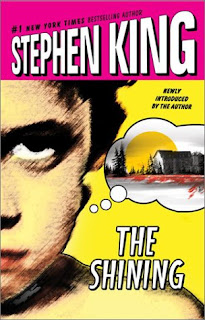
The Shining by Stephen King


My old post for The Shining was unnecessarily verbose and boring, so I decided to make a podcast out of it.

Listen to it here.


If you don't feel up for it, here's the short version.

It's a classic for a good reason. King has a powerful grip on characterization.

Jack Torrance is an entitled, angry, self-pitying dick. I don't understand how Stephen King expects us to have sympathy for him.

I didn't buy that Wendy would have stayed with him.

And hedge monsters aren't scary.

Seriously, just listen to the podcast.

Monday, May 25, 2009

The Shining (special concussion edition of Creature Cast)

We are, of course, referring to the Stanley Kubrick movie, not the anemic made-for-TV film from the 90s.


That Stanley Kubrick's film is a classic of the genre is beyond question. It's successfully scared the crap out of me for years, and each time I return to it I find something new to be frightened of. Instead, I want to talk about a few subjects that come up around the film, specifically the characterization of Wendy Torrance, Jack Nicholson's iconic performance, and the notion that there isn't anything supernatural going on in the Overlook Hotel.

1) The characterization of Wendy Torrance.


There are a whole lotta people who can't stand Wendy Torrance. She's funny looking, she acts like a doormat, and she keeps doing completely illogical things as the situation worsens. She comes off, frankly, as an apologetic wimp, trying to reconcile with her deranged husband as he keeps shelling out abuse on her.

All that stuff made her interesting.

First off, if she was truly a strong woman, she probably would have gotten the fuck out of the relationship ages ago and then we wouldn't have had a story. Second, there's a weird apologetic need horror types have around including the Strong Female Protagonist.

One of the criticisms that swirled around Quarantine was the fact that lead character Angela Vidal wasn't particularly tough or capable. Given that the actress portraying her was also the hard-boiled cop from Dexter, a lot of people were upset that she played the character as weak and confused. But that's precisely how I'd be if I were trapped in an apartment building full of screeching plague victims. I think people's natural reaction to horror is to be horrified, but the standard for female horror protagonists has become characters who treat the supernatural with a mix of terror and annoyance and who are infinitely capable of fighting back.

The re-characterization of Wendy Torrance was one of the big problems I had with the made-for-TV version of The Shining. As played by Rebecca De Mornay, Wendy is too strong, too capable, and would probably have ditched her husband long before he ever set foot in the Overlook. Then again, the TV series also completely removed culpability from Jack Torrance, making him a total slave of the house. Maybe he was a nicer guy in that world, who knows?

In Kubrick's version, Wendy Torrance is an abuse victim to the core. Her self-esteem has been completely eroded, she rationalizes her crazy husband's behavior, and she is high-strung and close to the edge of sanity. It's a painful portrayal to watch, and there are a lot of people who have some weird pathological need to hate that kind of weakness and pass judgment on her, but she was a great character and one of my all-time favorite final girls.

2) Jack Nicholson's performance...


ain't my favorite.

Okay, once he goes full-tilt nutso on Wendy, he gives one of the most iconic performances in history. By that point in the film he's become a cauldron of rage, spousal abuse personified. He's a lot less likable than the Jack Torrance from the novel, who really was a victim of the house's influence. He's pretty much a prick throughout the movie, long before the Overlook gets its claws in him.

Final Girl stated it better than I will, but when Jack begins his descent into madness there's no subtlety to it. We never see him question the visions he's seeing or resist the house's call to murder his family. He goes bug eyed, he licks his lips like the Joker, and he acts like your generic homeless nutjob. The performance is completely over-the-top, which works better late in the movie than in the earlier, quieter scenes.

I could probably make some pointed comparisons to his work in One Flew Over The Cuckoo's Nest but I've got a concussion.

3) What if nothing supernatural is going on in the Overlook?


I don't remember where I first heard this theory, maybe in John McCarty's Movie Psychos and Madmen, but people have occasionally made the argument that nothing supernatural is going on at the Overlook, that the isolation and pre-existing neurosis of the family is creating all the occult occurrences. No one witnesses the same haunting the same way, every character in the hotel undergoes some sort of mental collapse, and all the events that occur come from within the characters.

If there was ever a place to have a complete break from reality, it would be the isolation of the Overlook Hotel. You can imagine the place brimming with life during the tourist season, where there are people filling its vast halls, taking in the breathtaking vistas that Kubrick shows us. It's actually quite a beautiful place. Isolation brings a real sense of menace to all that enclosed space. I've given myself the creeps going through long, luxurious hotel hallways late at night. There's something about the light, the patterns on the floor, and all those silent doors, stretching out into near-infinity that just creeps me right the fuck out. It's not impossible that environments like this would drive a family over the edge.

Obviously, this theory falls apart on close inspection. Both Hallorann and Danny Torrance clearly have some psychic bond, someone had to let Jack out of the pantry after Wendy locks him in there, and Jack Torrance appears in the old group photo at the movie's end. But it doesn't take much effort to shoehorn this particular interpretation of the movie, and I think the story is all the richer for it.

Anyway, that's what I got for you today. Now, cleanse the palette with the best Simpsons parody evah!


Also, please don't drink and drive. You might hit a blogger who NEEDS his brain to work properly.

Saturday, October 11, 2008

Heart Shaped Box


Man, I didn't expect to be jumping into the reviews so early. I thought I had more essays to write, more nonsense to cheerfully babble into the ether, before I got down to the hard task of letting people know my opinions on stuff. But I had a weird week this week, and insomnia came part of the package. At sometime around 5:22AM this morning, I finally finished Joe Hill's debut novel, Heart Shaped Box and I got some thoughts on it I want to share.

I've been really excited about reading this one. It's probably no secret by now that Joe Hill is Stephen King's kid, and while it's not necessarily fair for me as a reader to be bringing expectations to his work based on my experiences as a Constant Reader of his father's books, I'm only human. King had a strong effect on me as a young teenager and I wanted to see what's been distilled into him, and what he's made his own.

By and large, Heart Shaped Box succeeds. Joe Hill's got game, and it's very much his own. Heart Shaped Box passed my two basic tests for genre work: Does it successfully create a strong atmosphere of dread and does the story/characterization stand on it's own without the horrific elements.

I found myself genuinely engaged with the leads. My general problem with most horror fiction is that the characterization tends to be painfully bland: Brooding But Capable Guy With A Dark Past, Plucky Yet Strangely Conservative Girl, Likeable First Victim, Irritating Complication Character The Villain Later Uses Against The Protagonists. Washed up heavy metal icon Judas Coyne, the unfortunate Danny Wooten, and the damaged Georgia are unique creations, their lives framed with tragedy and their dialogue deeply Southern in inflection. Put bluntly, I give a shit about these characters and strong reader identification is much more essential in horror fiction than in horror films.

One thing that I particularly appreciated was the evolution of Jude and Georgia as the story progressed. Judas Coyne is clearly depicted as a man who both carries and welcomes pain into his life, both from his guilt at outliving his bandmates to his intense immersion within his childhood trauma to his constantly rotating harem of damaged goods runaway girlfriends. I really appreciated the fact that the guy Jude is at the end of the story isn't the same selfish, disconnected, emotionally abusive prick that he was at the story, and that the transformation felt natural and not like some I-Have-Seen-The-Light moment. I dug the fact that Georgia (later Marybeth) can start out as a stereotypical shrewish, grating rawk star groupie and become sweet and sad and strong by the end.

As for the ghost Judas foolishly purchases off the interwebs.....ooooh. The ghost of Craddock is one creepy, creepy dude. He creates a very strong presence in the work, and his rage works in very cool, clever ways. He tends to pop up a little bit too often, and the bit about Craddock's spirit using tricks on Jude that he picked up while serving as a psychological warfare officer in 'Nam is kinda goofy, but otherwise I think he's a worthy boogeyman to add to the horror field.

A very intense southern gothic sensibility fills Heart Shaped Box and I dug these elements. The character's melancholy and family strife brought me into their world very effectively.

The story was not perfect, by any sense of the imagination. The story is so lean and so intensely focused on the leads that it feels at times like a drawn out version of a shorter piece. As such, certain passages feel longer than necessary. While I thought the early haunting in the book were more effectively scary, I would have liked to see Jude and Georgia get on the road quicker, if that's where they're truly meant to find salvation.

Jude and Georgia become much more interesting on the road. Unfortunately, putting them on the road eliminates the claustrophobic effect that Craddock's ghost has inside Jude's home. While the lyricism of the Craddock's frequent threatening broadcasts over haunted radios and TVs offers some of the best chills in the book, I felt his vengeful spirit became less threatening as the narrative progressed.

One of the more effective elements of my favorite haunting stories is the idea of characters who have to confront the things from their past as they're fending off the supernatural. Jude's alcoholic, abusive father looms heavily in Jude's characterization, yet the inevitable final meeting between father and son fails to hold much confrontation or catharsis, as the dying man becomes yet another vessel for Craddock to attack Jude. I would have liked to see this scene expanded, especially since Jude's childhood was profoundly affected by the abuse he suffered at the man's hands.

Oh, and a quibbler's note: the definition of "goth" that Hill uses tends to be pretty far away from the Gothic subculture as I've experienced it. Black nail polish and sour faced tales of childhood trauma does not a goth make.

Anyway, give this one a look-see. I dug it for the traditional ghost story elements and the unique and energetic prose.

ia ia cthulhu fhtagn

Creature