Friday, April 30, 2010

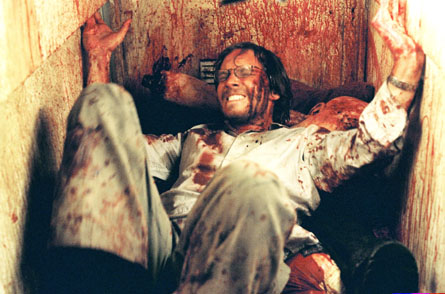
A Nightmare on Elm Street (2010)


Shhh. Don't tell anyone, but I already outlined my review before going to see the movie. Here's the outline, unedited:

1) Jackie Earle Haley brought the scare back. Platinum Dunes knows how to cast 'em.
2) I hate hate HATE the constant soundtrack spike jump scare.
3) Teenagers bore me.
4) Harp on the whole "Freddy was always a pedophile" argument again.
5) Fun but dissatisfying, like McDonalds or sex with an ex.

Most of my little predictions turned out to be correct. Jackie Earle Haley was genuinely creepy. No disrespect to Robert Englund, but Freddy had become way too cartoony over the course of the series. You had to clean the slate completely over the course of a reimagining and, love 'em or hate 'em, Platunim Dunes knows how to cast a monster.

I very carefully avoided reviews of the movie before seeing it. I heard through the grapevine that it wasn’t getting good reviews, but horror movies never do. I did chance on Roger Ebert’s review of it where he accused Wes Craven of being the “Ray Kroc of horror”, which I found both distasteful and dismissive. It’s no secret that he doesn’t care for a lot of the stuff I really like and it’s no secret he’s become the crazy old coot who constantly rails against the things my generation does, but his review is very flip and he completely blows off the contribution Craven has made to our cultural landscape. You don’t have to like ‘em, but creating monsters is just as valid and valuable as any other art form. It’s meant a lot to me, at any rate.


I don’t think I cared for the movie all that much. The nicest thing you could say about it was that it was unambitious. There’s a lot of subtextual meat on Nightmare’s bones that the filmmakers don’t particularly seem interested in exploring. It’s just happy to scream in your face every few minutes. The screenplay is terrible, with character moments constantly interrupted by god-awful dialogue that sounds leaden and off-key. The only time the movie really comes alive is when Freddy is on-screen.

One thing that struck me as most interesting about the new Freddy was how different his characterization felt. The original Freddy was evil in a kind of simplistically joyful way; he basically gets off on hurting people. We don’t really have a sense of who he is prior to his death and he carries off his role of dream murderer with a malicious glee that made him curiously likeable. We don’t think too deep on his crimes because he’s a lot of fun to watch.

Haley’s Freddy is much, much angrier. We see him when he’s alive and it’s clear he’s a very sick man. In the flashbacks of his life, he portrays Freddy as apparently suffering from a mild form of retardation, and his death at the hands of the enraged parents is almost tragic. His Freddy isn’t the callow sneering demon of the Robert Englund day. The new Freddy is a sniveling little shit made monstrous by his murder.

He’s also got a more specific reason for going after his victims. While the original Freddy seemed to be targeting all the kids in Springwood, the new Freddy is killing the children who told their parents about his hidden playroom and the terrible things he did to them. One of the movie’s big redeeming factors for me was that it dealt explicitly with something that has always run through Freddy’s mythology, which were his crimes as a child molester.

There’s a lot of fans in the horror community who are up in arms over Freddy being “recast” as a pedophile. I don’t really get that. It’s always been fairly clear to me from the get-go that he was a child molester. His taunting has always had a leering, sexual edge and the only reason they never went into it in depth is that pedophilia is always a taboo subject, even in a gory horror film. Slasher movies have always had a preoccupation with sexuality and the leering gaze, but Freddy has always been pretty explicit about his predilections. Really, why does he always have little blonde girls following him around, showing victims the boiler room and saying “this is where he takes us…” This movie deals heavily with repressed memory and the long reach of childhood sexual trauma. The characters haven’t healed from it and it reaches out to affect their lives. The scene where the two remaining kids find Freddy’s hidden chamber is genuinely disturbing in a way very little of this movie is.


One of the things that ties into the motif is the parent’s conspiracy of silence. Slasher movies are always about isolating the teenagers from their forces of authority, usually by getting them into an abandoned something-or-another. Here, the isolation comes from the parents not believing the kid’s admittedly outlandish claims and concealing their complicity in Freddy’s murder.

The rest of the cast is pretty good too. I never quite warmed up to this movie’s version of Nancy. She’s really cute and kinda looks like Felicia Day from The Guild, but her performance is wildly uneven. Is she the aloof, guarded artist? The shy loner? The angry teenage rebel? She’s more interesting than the bland fake-out final girl we initially follow, but she’s ultimately too impenetrable to win my sympathies. The male characters are slightly more interesting. Aside from being better actors, they portray the stress and fear of crossing over into Freddy’s hellish world much more believably. I don’t’ remember where I read this, but I remember that Thomas Dekker gave an interview where he said that he wanted to portray Dean as scared out of his mind, rather than as the stoic male lead we’ve come to expect. He did a great job and I’m never going to be more creeped out by the words “We’ve still got six minutes to play.”

It’s also funny to note that Friday the 13th’s Aaron Yoo has a cameo appearance as another one of Freddy’s victims. I like that guy, but every time I see him some maniac uses his face as a speed bag. At the rate he’s going I feel Platinum Dunes owes the poor guy a chance to balance the books. Maybe when they inevitably get around to remaking Child’s Play he can stuff Chucky into an industrial-grade printing press or something.

I really liked the whole notion of the micro-naps. One of my favorite parts of all the Freddy movies are how the real world and the dreaming world intersect as the victims become more and more sleepy. This movie gives a stronger reason for this phenomena, and some really trippy stuff starts to happen. I particularly liked the bit in the pharmacy, where Freddy’s dream-self takes big swipes at Nancy, knocking over stuff from the shelves.


In the end, I guess I was vaguely disappointed by it. It was nice to see Freddy doing his thing again and I really liked Haley’s performance in the role, but there wasn’t a lot more to the movie besides jump-shock scares. I try to be kinder about Platinum Dunes movies than a lot of my fellow commentators, especially because they’re keeping my favorite icons alive, but they seem to think of horror as a sledgehammer with which to bludgeon an audience. All the classic scenes from the original are there, but they're amped up to ten. The girl doesn't crawl up the wall, she's violently slammed around the bedroom. Freddy doesn't eerily stretch out of Nancy's wallpaper, he pushes out of it like bad CGI from The Haunted. Sigh.

There’s very little attempt to building any real tension or creating any sort of creeping dread. I get a bunch of jolts, which always leaves me twitchy and nervous, and I can leave the movie behind at the theater. It doesn’t follow me home, it doesn’t tuck me in bed late at night, it doesn’t stand over me while I sleep, waiting for me to open my eyes.

What’s worse is that, even though they work in a very formulaic subgenre, the movies Platinum Dunes have made come off feeling very cold. The people involved are too experienced and professional to make movies that have the weird amateurish enthusiasm of the classic slasher flicks. The stars are all very good looking and marketable, the camera work is very skilled, and the watching the movie feels like watching a technically skills if emotionless ballet. Bitch about Zombie's Halloween remake all you want, but at least that had soul. It was ugly, unpleasant soul, but it was there.

Walking away from the movie, I sort of wondered if the makers actually have any reverence for the genre at all, or if they are cynically aware that idiots like me will keep paying money as long as there’s some nostalgia involved.

Whatever. I can’t wait for the sequel.

Thursday, April 22, 2010

Toxic Ideas in Horror Fiction


Recently a friend of mine loaned me a horror novel. The author was a big name who I've been meaning to check out for some time and a previous winner of the Bram Stoker Award. I was looking forward to the book, but somewhere between the unpleasantness of the lead characters, the overly-caustic tough guy dialogue, and the trite Stephen-King-Did-It-Better menace, I found myself feeling the same despair I feel every time I pick up an issue of Fangoria and seeing nothing but direct-to-video zombie movies. Are there any new ideas? Is there anything really innovative in our genre or are we doomed to keep retreading the same ground like Michael Myers on a slow-moving treadmill.

One of the things that really didn't sit too well with me while reading the book was how painfully familiar it all felt. The story revolved around a mysterious supernatural threat that befalls a small suburban town. The residence succumb to madness and violence as the thin veneer of civilization is stripped away and people blah de blah de fucking blah.

I get that horror isn't exactly an optimistic genre, but I've seen this theme done to death. Plus, I don't think it's a really accurate portrayal of humanity. Constantly harping on the evil inherent in humanity completely misses out on our higher aspects. Even if an idea is old there's still some value in exploring it, but it needs to lie fallow for a time.

With that, I want to look at a few themes that really need to be put on the backburner. I'll probably expand this list as times goes on, but these are the subjects that bug me the most.

1) There were some things Man was not meant to know.


This one really drives me nuts.

I get where this one comes from. You used to see this theme a lot in the creature features of the 50s, when atomic warfare seemed destined to wipe the human race off the planet. Hell, this theme goes all the way back to the roots of the horror genre, when the mad doctor Frankenstein spits in the eye of God and loses control of his blasphemous creation. While I understand people's phobias about atomic destruction, it seems like every time some new piece of technology emerges some jackass makes a ham-handed cautionary tale of how it could go wrong.

Me, I like technology. Lord knows I don't get it, but I like it.

I'm with Spider Jerusalem on this one: the future is inherently a good thing. The future represents an opportunity to crawl further away from the mean roots of our humanity and embrace something better. Change doesn't necessarily have to be a bad thing. We want change. We want new things. We want to know that there's a newer, brighter land on the other side of the mountain. What we don't want is some dire monastic killjoy nervously whispering to us that everything could fall apart and we're better off staying where we are. If humanity believed that, we'd still be flopping in the muck instead of swaggering around Williamsburg with ironic moustaches.

2) Sexual promiscuity is a moral failing and punishable by death.


I've covered this one before at great length but it still keeps coming up and it still keeps pissing me me off.

One of my heroes, author and sex advice columnist Dan Savage, once wrote that slutting around is like travel; it broadens the mind. Now, while I do believe it depends on the mind in question, I subscribe to the idea that sex and sexuality isn't intrinsically bad and that it's part of life. But then I'm a godless liberal educated city-dweller type, born in San Francisco and living in New York. In summation of my previous arguments, uptight virginal characters are boring and it's a bit puritanical to bump off characters who have the audacity to have sex on-camera. It's like we want to see them do it, then we want to see them punished. What the fuck is that about?

I've recently been revisiting slasher classics and one thing I couldn't help but notice is that I can't think of many final girls who are clearly labeled as virgins. Many of them have boyfriends, some of them are actually quite forward (Ginny from Friday the 13th part 2 and Megan from Friday the 13th part 6), and they seem more bothered by their friend's boneheadedness than their promiscuity. Sure, they're often outsiders in their groups but that's because they're brainier and more mature than their friends. On the other hand, abstinence is usually a big part of their survival, if only because they're paying attention to their environments rather than their bacchanalian excesses.

One of the things I really liked about Wrong Turn 2 is that the final girl clearly isn't a virgin. She's damaged goods, we get the sense that she's lived an interesting life, and we know that the shit she's been through gives her the tools she needs to survive.

As I've said before, let the sluts and the stoners live. They're usually more likable, more interesting, and probably better equipped to survive because their brains haven't been turned into anxiety-flavored taffy by a lifetime of conservative dogma.

3) Humanity falls apart once the light goes out.


I object to a lot of these themes on moral or intellectual grounds. I'm just plain sick of this one.

You've seen this one as far back as The Monsters Are Due On Maple Street. A community is isolated from the world, some weird shit happens, and everyone turns against each other. There's lynching and looting and chest thumping and oh-my-god-civilization-is-a-thin-veneer-over-primitive-madness. The idea of going all Lord of the Flies on your neighbors holds some gruesome appeal, but at this point it's become tiresome.

I really don't think horror gives humanity enough credit. Sure, when disasters happen, there's looting and civil unrest, but there's also tons of people donating blood and digging through wreckage and doing their best to keep their fellow humans warm and sheltered and safe. I don't know about you, but I find that side of humanity inspiring. The fact that horror never seems to acknowledge that side of our character puts me in mind of an angsty teenager who only chooses to see the worst in everything because it fits with his bleak and hormone-soaked world view. In other words, it reminds me of myself at fourteen.

4) Pacifism is a useless, high-minded ideal.


This one comes up a lot in stories that involve fierce survival situations, like The Hills Have Eyes or Joe R. Lansdale's The Nightrunners, where innocent, good-natured city types are beset by territorial cannibals or sadistic ghouls or vicious hoodlums. Most of the time there's one guy in the group who is singled out as the wimpy but good-hearted pacifist who ever imagine harming another human being but is eventually forced to reconnect with his bloody, savage natural instincts in order to survive. Sometimes this is framed as part of the horror, as the poor man (and it's ALWAYS a man) becomes just as savage as the monsters he fights, but most of the time we're clearly meant to be impatient with the wimp and to celebrate the time he embraces his manhood and clubs the mewling, wounded monster to death with a big hunk of wood.

Of course, the gimmick of having a character put in a situation that forces him to work against his limitations is straight out of Dramatic Conflict 101 and it's so familiar at this point that it's simply exhausting. What bothers me most in this theme is the narrow-minded definition of masculinity at the center of it. Sure, when you're put in a situation where it's kill or be killed against a bunch of snarling monsters the choice is a no-brainer. But there's something vaguely simplistic and mean-spirited about the whole idea.

I myself am some sort of a pacifist, partially because I'd never win a fight and partially because I believe it's a losing game to measure your masculinity based on whose ass you can kick, but in horror that attitude is framed as a character weakness. The pacifist is always the most cowardly, the most snotty, the most unwilling to adapt, and, bluntly, the most stupid character in the group. All pacifist characters come off as red-state stereotypes about educated people. What we need is a good solid push so we can start kicking righteous ass. It touches on some ugly, outdated ideas of what a man is supposed to be.

Conclusion

I have no doubt I'm going to add to this list. I pay a lot of attention to subtext and horror is full of dodgy ideas and puritanical subtext. At some point I want to do an article on the age old misogyny question, but for right now I'll leave it at these. Readers, if you've got any other good ones, send 'em my way.

Wednesday, March 31, 2010

The House of the Devil


Horror is a funny old bird.

There are some stores that contain tremendous depth, with rich characters and fascinating mythologies and engaging narratives. The people who created these stories were trying to create something with more layers than simple fear, and I keep going back to the best examples of these works. I keep going back to stuff like The Shining and Romero's Zombie movies and Clive Barker's output. There's a lot to explore and take in.

But under Horror's dark wing exists the campfire tale. You're sitting in the dark, the fire is crackling, and that seductive voice whispers to you, sketching out the tale. The storyline is direct and primal, with very little to get in the way of the horror. Which is not to say that it's shallow. When done right, the campfire story is an engine, precisely crafted to scare the living crap out of you. Every once in awhile you get something really well made, where the craft of constructing tension and suspense raises up to the level of art. Some campfire stories have the grace and poise of ballet.

In other words, I really liked The House of the Devil.

I'm really late to the party. Many other people have lined up to kiss this movie's ass and they did a better job than I can. There's really not much to say about HotD other than it's brilliantly made and I want to see what else this Ti West guy can do.

The Tension


One of the first things that struck me after I finished HotD was how effectively scary it was.

A long stretch of the movie involves Samantha, the desperate-for-cash girl who takes a really sketchy babysitter gig in a creepy house on the outskirts of town, wandering around a creepy old house by herself. In terms of narrative stuff, not a lot happens. She pokes around the place, watches some TV, and wanders down some creepy old corridors. When written, it sounds boring, but the way Ti West filmed it lead to an atmosphere of almost unbelievable tension. I realized something while watching Samantha in the house: this is the kind of horror I can relate to.

I'm typing this update after hours in my office in New York. I'm alone in this large hollow office space, with only the hum of the building's heating engines keeping me company. It's eerie. I've felt these feelings a thousand times in my life but horror rarely explores the discomfort of being in a strange place with the depth and patience of HotD. Like many movies that rely on atmosphere, I don't know how worthwhile repeat viewings would be, but watching her explore the Bad Place was incredibly chilling.

The 80s


HotD is set in the 80s and a lot of people have commented on the little touches outlining the setting, from the 80s-inspired opening credits to the feathered hair and the big-ass Walkmans Sam totes around. Most of the commentators I've read are kids of the 80s and those little touches bring back fond memories of watching crappy VHS movies.

The setting never feels like a gimmick. Part of the reason West set his story in the 80s is that he wanted to circumvent the whole stupid "there's no cell phone signal" thing. I think this is brilliant. Horror depends on isolation and cell phones have made it too easy to call for help. Someone someday will come up with a brilliant permanent fix for this problem, but HotD's trick of setting the movie before the technology became commonplace is a good dodge.

Satanism


The other major reason West set the movie in the 80s was due to the cultural paranoia around Satanism. I remember those days. We didn't really worry about Satanists growing up in hippy-dippy San Francisco, but I remember talk show TV "exposes" on Satanist cults and all the movies from that era. There really was a cultural paranoia about the hidden Satanic cult next door looking to sacrifice your baby. In retrospect the whole thing seems goofy, but it's fun stuff to tap into.

In retrospect, the movie isn't particularly Satanic. It takes a long time to get to the pentagrams and the rituals and the hypnotized victim. When Sam is confronted by the head cultists in the graveyard, he speaks of Satan very indirectly. I thought this was a nice touch as many movie cultist-types tend toward the gloating villain speech. In HotD he implores Samantha to return with him and he sees her violation as a great gift. He's not a very threatening figure and his neediness makes him a great character.

Self-Referential


I've gone on rants about how horror directors who have too much fondness for the genre tend to make campy, over-the-top horror with varying degrees of success. They're often fun to watch, but they usually end up feeling a little too self-aware and reverential. I'm really happy that West, a clear genre enthusiast, took the atmosphere seriously.

HotD doesn't constantly wink at you. The gore is present and nasty but it's not as theatrically excessive as many horror fans seem to prefer. The emphasis was clearly on atmosphere and it accomplished the job delightfully. The actors aren't hamming it up and the characters aren't reference-laden quip machines. They're likeable and jokey without being buffoons.

Samantha


I really liked Samantha. She reminded me, in a lot of ways, of Jamie Lee Curtis's character from Halloween, in that we got as much of a sense of her practicality as her social restraint. People love analysing what Final Girls mean but I think one of their defining attributes is that they tend to be grounded, practical people.

A lot of her personality comes through as she deals with her desperate financial straits. Maybe it's because I just moved to a new city and I'm broke as fuck right now, but I empathized with the hassles Samantha experienced in finding a new place and I probably would have taken the creepy old man up on his offer, too. A lot of movies love to harp on the whole "money is the root of all evil" chestnut, but the simple fact is that money is like food: you need it to get by.

The other thing I really liked about Samantha is the fact that, like the capable Ms. Strode before her, she can kick a surprising amount of ass when called to. She isn't an invincible superchick, but when the hammer falls she does real damage to her pursuers. I was really impressed with the way the character handled herself. She truly was heroic. While I don't want to give away the ending, I gotta say that it took cojones to do what she did. It's out of my league.

Also, while I'm on the cast, props to Tom Noonan as the creepy old guy who offers Samantha the job. He's that right mix of being harmless and just a little off. I really liked his work.


The Pacing


The last thing I wanted to talk about is the most divisive issue of the movie, which is the slow pacing of the narrative. The runny-runny-stabby-stabby stuff all happens within the last half-hour or so, so most of the movie has a slow-burn effect as Samantha takes a really sketchy job and explores this creepy old house.

West has said in interviews that he was trying to ape the narrative structure of many classic horror movies, especially the original Halloween, where the big payoff didn't happen until the tail end of the movie. Some detractors say the movie is too slow-paced and nothing happened, while others say that the first group is a bunch of simpletons who only care about gore and guts and shallow instant gratification.

Me, I'm on the fence.

A slower, most classic sense of pacing doesn't automatically make a better movie. I've seen other filmmakers try it and was bored to tears by the result. However, most of the people who want hard, fast, relentlessly gory horror often have lost their capacity to appreciate anything with any subtlety. I have spent years defending The Blair Witch Project against these kind of arguments.

Ultimately there are going to be people who are turned off by HotD but there was enough meat on those bones to keep me thoroughly entertained.

Go check it out. And keep an eye on this guy. I like his style.

This post is part of the Final Girl Film Club. For those of you who dug this post, welcome to my humble little blog. I'm a big horror fan and I like to apply my highly-honed, liberal-arts education bullshit shellacking skills to the stuff I enjoy. I cover movies, books, games, and music. We also got a podcast here. Welcome aboard!

Tuesday, March 30, 2010

This Year's Bram Stoker Award Winners


Every year the Horror Writers Association presents the Bram Stoker writer's award at the World Horror Convention. I like to follow these as they give you an excellent reading list for the year. They just published their recent list of winners and I thought I'd share 'em with you. I always go for the first novelist winners first. It's a great way to get on the ground floor with some new talent.

Happy hauntings, fellow ghouls!

Novel: Audrey's Door, Sarah Langan (Harper)
First Novel: Damnable, Hank Schwaeble (Jove)
Long Fiction: The Lucid Dreaming, Lisa Morton (Bad Moon Books)
Short Fiction: In The Porches Of My Ears, Norman Prentiss (PS Publishing)
Anthology: He Is Legend: An Anthology Celebrating Richard Matheson, Christopher Conlon (ed.) (Gauntlet Press)
Collection: A Taste of Tenderloin, Gene O'Neill (Apex Book Company)
Non-Fiction: Writers Workshop of Horror, Michael Knost (Woodland Press)
Poetry: Chimeric Machines, Lucy A. Snyder (Creative Guy Publishing)

Thursday, March 11, 2010

The Academy Awards Tribute to Horror


This past week during the Academy Award ceremonies, Taylor Lautner and Kristen Stewart of Twilight fame came onstage to present a tribute to the great horror films of yesteryear. Almost immediately, the internet horror community blew in righteous indignation. How dare they bring up the kids from Twilight. Why did they keep using the same movies in their montage? Blah blah blah.

Shut up.

Maybe I hold a subconscious wish that the genre was given more legitimacy in the mainstream, but it's nice to be acknowledged. It's nice to hear that horror is still the most popular genre and that many of the biggest names in the industry got their start scaring people. It's nice to see scenes from Evil Dead 2 and Leprechaun played at a big Hollywood event.

It's nice to be appreciated.

But then, I was always a softie.

Saturday, February 27, 2010

My favorite horror romances

Ah love. Stupid, stupid love.

All the great stories are love stories. The passion and the pain all lie at the heart of immortal drama. Indeed, love is the engine that moves the heart of the world.

I've been thinking about love a lot lately. Maybe it's because of Valentine's Day, maybe it's because the snow brings me into an intimate frame of mind, maybe it's because I'm writing this while staying in my ex-girlfriend's apartment, but I'm in the mood to pontificate on the subject of love in horror films.

Back up. Horror and romance? Could those two emotions more opposed? Well, yeah, consider that the "heart" of all horror (if you'll pardon the expression) is the characters. Many horror movies tell surprisingly engaging love stories, even if they often don't end well. I've come up with a list of my favorite romances in horror. As always, feel free to add to this list.

The Monster and The Bride from Bride of Frankenstein


The classic fucked-up horror romance. Frankenstein's poor monster wants nothing more than a companion to share his horrible existence with. After a campaign of torment and brutality, Dr. Frankenstein capitulates and builds a bride for his monster. The Bride takes one look at her intended betrothed and screams in terror. For the damned creations of Frankenstein's madness, there is no relief from loneliness.

Tiffany and Chucky from Bride of Chucky


I always liked the Child's Play movies. For a series about a kickable doll, the movies were genuinely scary, mostly due to Chucky's amoral viciousness. Chucky always felt like a supernatural variation of one of those cross country spree-killers. With Bride of Chucky, Mickey finally got his Mallory.

Chucky and Tiffany are much like what I imagine Charles Starkweather and Caril Fugate would be like. They're deeply passionate for each other, but that passion often turns violent. Tiffany in particular seems to be let down by the fact that Chucky isn't the man she made him out to be in memory. Their relationship make for some rich dark comedy and heaven help those who get between them.

Julia and Frank from Hellraiser


The horror genre is rife with cheatin' women.

Remember all those Tales from the Crypt stories where some woman conspires with her lover to kill her husband, only to have supernatural vengeance befall them. Hellraiser takes that trope to the farthest borders of sensation as it tells the story of Frank and Julia.

Julia and Frank fuck. Fucking is central to the Hellraiser mythology, as demonic S&M monsters offer unparalleled sensual delights to the hedonists who seek them. Frank had already crossed over into the Cenobite's perverse realm and reaches out to his former lover in an attempt to escape.

Julia spends most of the movie as a wicked stepmother, cold and aloof to her family. Frank's return reignites her passion and she follows him down the path to damnation. It doesn't work out in the end and there's betrayal and brutality, but few pairings match Frank and Julia for raw, twisted sexuality.

Kristen and James from The Strangers


I like to think of this one as a snapshot moment in a relationship.

Kristen and James were at a wedding. Romance was in the air and the two seemed like a happy couple. James pops the question. Kristen turns him down. They go back to James' parents house. James had decorated the place with candles and roses and other stuff to celebrate their unfulfilled engagement. The gesture, while sweet, makes everything more awkward after the rejection. While they're dealing with their emotions, a bunch of asshole kids show up. We have a movie.

I have been where James and Kristen have been. I've run up into those moments where I had to stop and consider what my relationship meant and whether or not it could survive. Their awkwardness and sadness resonated with me. They're not mad at each other, but you see them walking around in a daze, trying to put words to the things they are feeling.

We never learn why Kristen rejected James' proposal and their relationship comes to a very tragic ending, but I cared about them very deeply and I wanted them to make it. Too bad the Dark Gods of Narrative aren't as sentimental as I am.

Tina and Nick from Friday the 13th Part 7: The New Blood


This one may be a cheat.

We never see any obvious declarations of love between Tina, the troubled psychic and Kevin, the bad boy turned good. They never hold hands and watch the sunrise over Crystal Lake. But both of them are outsiders, neither of them fit into the respective groups that come visiting the lake. They do have some nice moments of connection before the mayhem starts. Kevin was one of the few males to survive a Friday the 13th movie and that has to mean something, right?

I like to think that, once the wounds are healed and the trauma is dealt with, the two of them could find some kind of peace with each other. Tina definitely deserves it. Bad News Krews certainly wasn't helping her out.

James and Mary from Silent Hill 2


Considered by many to be the high point of the Silent Hill series, Silent Hill 2 set up most of the tropes that continued through the later entries, particularly the idea that Silent Hill is a purgatory for people haunted by their past.

The story centers around James, who receives a letter from his dead wife telling him to meet her in the fog-shrouded town of Silent Hill. As the story continues, we discover that James' wife suffered a long illness and he smothered her with a pillow, ostensibly to prevent her from suffering further. When he arrives in Silent Hill, manifestations of his guilt come alive to punish him for his actions. The player makes choices in-game that determine what kind of ending James gets. Most of them aren't good.

Silent Hill 2 is an amazing horror story. The visuals are genuinely chilling, and the story of lost love and crippling guilt is genuinely heartbreaking, framed by some of the most chilling scenes I've ever experienced in the genre.

Dracula and Mina from Bram Stoker's Dracula


I'm mostly including this as for nostalgia purposes. I can't stand this movie anymore.

Okay, let's be fair: Coppola can direct a pretty movie. The costumes are gorgeous. The performances are...memorable. And it's a fun movie to watch.

When I was a young goth kid, I took this movie sooooo seriously. The romance was soooo intense and sooooo beautiful and squee! isn't it romantic how he crossed oceans of time to find her?

Now I find it hackey and melodramatic and almost unbearably embarrassing to watch, probably the same way other people view Twilight. I can't say that young romantic in me doesn't still have a warm place in his heart for this movie, but it's an over-the-top bodice ripper.

Ana and Michael from Dawn of the Dead (2004)


There are three major relationships in Dawn of the Dead. One is between a guy and his infected pregnant wife, but that's about his fixation to bring something better than himself into the world. The other is between two stupid pie-eyed teenagers. The last is between Ana and Michael. It never quite blossoms into what it was meant to be, but there is such tenderness in the tension between them.

Michael is a genuinely good guy. He's smart, compassionate, sensible, and a born leader. While certainly capable, he never has the bluster or bravado of the other characters. Ana is very much his equal, as intelligent and capable as he is. While they're both practical people and the situation demands that they never let their guard down, we feel the intensity between them. We get the sense that, if the world were to once again stabilize, they could be very happy together.

Their relationship is cut short in one of the most heartbreaking ways I've ever seen in a horror film, but Michael even goes to his death with the kind of quiet brave dignity that is to be admired. In an era where most male heroes are rogues and brutes, Michael is the kind of guy I would like to be someday.


Candyman and Helen in Candyman


Wait a sec. Another overly romantic movie about a supernatural creature romancing a human?

Well, yeah, but unlike Bram Stoker's Dracula, the love isn't reciprocated. Candyman is essentially the story of a supernatural stalker. Sure, he's intensely charismatic and romantic, but he's also evil to the bone, and he completely destroys Helen's life in the pursuit of her. Like Dracula, he also invites Helen to be like him, but the process involves a death so horrible it would become legend. The course of true love never did run smooth.

Stephen and Francine from Dawn of the Dead (1978)


Stephen and Francine didn't hold up too well.

I always got the sense that Stephen and Francine would have eventually broken up if the zombies didn't take over. As it stands, there's a lot of unspoken anger between them, and Francine in particular seems often resentful that they've been thrown together. Even though Francine is pregnant, there's no sense of joy or togetherness about it. They seem to treat it as just another problem in a hellish world.

There's something vaguely sexist to Stephen's behavior. He gets irritated when Francine voices a contrary opinion, dislikes the idea of her flying the helicopter, and nearly gets her killed when he leaves her alone to have a manly adventure with the SWAT team boys. Even their lone romantic moment ends unhappily. One of my favorite shots in the movie takes place after the two of them have made love. Francine sits up, smoking a cigarette, looking past us. Stephen lies awake next to her, staring up at the ceiling. They no longer have anything to say to one another.

The most nightmarish image in the movie is when Stephen, now a zombie, goes after their safehouse. The movie often points out that zombies are compelled by unconscious desires, specifically to return to the mall. What if Stephen's unconscious desire is to hurt Francine?

Either way, it doesn't work out.

Marie and Alexa from High Tension


Oh, I'm gonna have to tread carefully with this one.

I've heard some people say this movie carries strong homophobic undertones. Final Girl covered that subject better than I could and I'm inclined to agree with what she says on the subject. Here's my take:

I liked the twist ending. Sure, maybe it was a gimmick and maybe it doesn't really add anything more to the story, but I like kicking around the idea of an obsession so intense that it manifests itself in such horrific delusions. If the disgusting pig of a truck driver is how Marie sees her attraction to Alex, that speaks of a poisonous self-hate. I would like to see a remake done where we are aware of the split from the beginning. There's a really, really good horror movie here.

Shaun and Liz from Shaun of the Dead


I have a soft spot for stories about about losers who find their inner hero when crisis hits. I like to think I have a little Shaun in me.

Anyway, there's a bunch of stuff I really like about Shaun of the Dead. The romance is authentic. Shaun is a likable guy and you can see why Liz stays with him as long as he does. When they do break up you can see it's because the little things finally wore her down. Even then, there's still enough good memories to make the break up difficult. Finally, I liked the skeevy friend who constantly undermined Shaun and Liz's relationship so he could have a shot at her. I've known that guy. Once I was that guy. Either way, it was a nice touch.

The one thing that always threw me about the movie was the ending. After the zombie threat is brought under control, we see Shaun and Liz back on Shaun's couch. She now seems happy that they're doing all the stuff she hated doing before. Why the sudden change of heart? Does she now appreciate his habits more, or is she now simply grateful to be alive. Whatchoo think?

Oskar and Eli from Let The Right One In


Young love can be incredibly messed up, especially when you're in love with a violent blood junkie.

I've said it before and I'll say it again: I don't think Oskar and Eli are going to last in the long term. Sooner or later Oskar will get old and Eli will be as brutal and dismissive as "she" was to poor Hakan. There is something fundamentally stunted about Eli and the sort of affair they would have is truly doomed in the "One day I will have to be a serial killer to please you" sort of way.


Doing a quick look over this list, I see a lot of doomed romance. Love doesn't tend to do well in horror, mostly because people tend not to do well in horror. Horror is often about things falling apart, usually by worst-case scenario. Still, the grand passions are what gives us our humanity. They pull us out of the darkness and draw us close together. They warm us like campfires as the dark slowly circles us, drawing us in...